Friday, 24 May 2013

Priestly grave clothes?

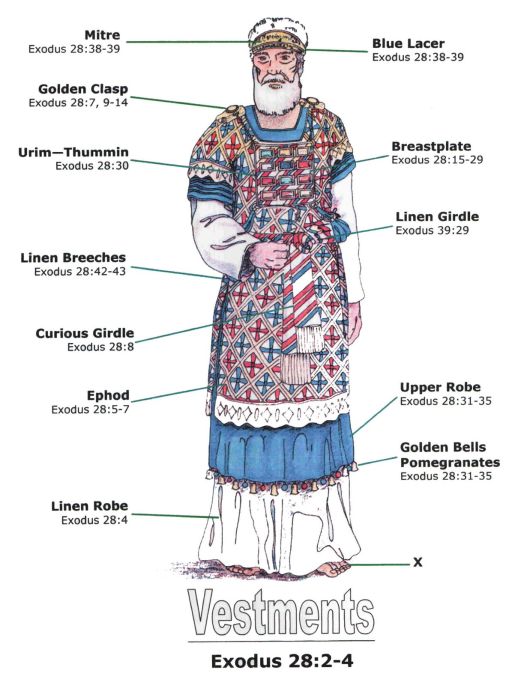
With thanks to http://raykliu.wordpress.com/2012/01/28/ephod/ - accessed 25.05.13
Could it be that the Priest's linen undergarments were to point to the grave clothes The One True High Priest would wear as He died for us?

Monday, 15 April 2013

The Lamb - Part 2

With thanks to http://christthetruth.files.wordpress.com/2009/11/eid-sacrifice22.jpg
The Lamb - Part 2

Last week, we started looking at the Lamb of God.  We found (in Revelation 6:15) that no-one - kings, generals, rich, powerful, slave or free - expects to be able to stand before the wrath of the Lamb … the Lamb, to whom (Revelation 5:13) every creature in heaven, on and under the earth, in the sea, and all that is in them ascribe blessing and honour and glory and might forever.

And we saw that John the Baptist identified this “Lamb of God” as Jesus (“the Lord who saves”) Christ (“the anointed one”), who takes away the sin of the world.

This lamb is clearly something - or someone - to be feared and respected: its wrath strikes terror; it receives all the honour in the world; and it will take away all sin.  … Pretty unusual activities for a lamb, to be fair!

It’s probably safe to presume that the title ‘lamb’ is more symbolic than actual - but, even so, why would such an ironic symbol be used for such a great hero?

Isaiah 53:6-7 may provide a clue:

All we like sheep have gone astray; we have turned - every one - to his own way; and the Lord has laid on him the iniquity of us all.  He was oppressed, and he was afflicted, yet he opened not his mouth; like a lamb that is led to the slaughter, and like a sheep that, before its shearers is silent, so he opened not his mouth.

Here, we have three references to sheep:

1.  Sheep go astray;

2.  The Lord lays on the sacrificial lamb the iniquity of the one slaying the lamb;

3.  Lambs led to the slaughter are silent.

Let’s have a look at each of these in turn.

1.  Sheep go astray.

Speaking of salvation, as we are, that sheep stray from the narrow path back to the Good Shepherd, as he is trying to lead us by still waters, is a great commentary on the human condition!

God has only ever had good in mind for us ever since the beginning of creation, but we have strayed so far from him that we can’t get back on our own.

I recently learned about the behaviour of sheep when they are lost.  Apparently, if a sheep gets lost from the rest of the flock, it seems to become paralysed in fear – even if a wolf approaches it, it will just remain rooted to the spot.  In fact, the wolf could quite happily saunter over at a very unhurried pace and there would be no risk whatsoever of the stupid sheep trying to run away.  Likewise, if the Shepherd, out looking for the sheep, calls it, it still does not respond - even if the Shepherd actually finds it and walks right up to it, it will not move.  There are two ways to break the paralysis: either the flock has to get around the lost sheep (bringing it ‘back into the fold’) or the Shepherd has to actually physically lift the sheep onto his shoulders and carry it back to the flock.

(Again, the similarities are uncanny!)

Jesus is The Good Shepherd, carrying us away from the jaws of death and back to green pastures, but he also took on flesh - taking human form - in order to redeem our flesh.  In this case, if we are represented as a flock of stupid sheep, it makes sense that, symbolically, he is also represented as ovine.

2.  The Lord lays on the sacrificial lamb the iniquity of the one slaying the lamb.

In Genesis 22, we read that, early one morning, Father Abraham - accompanied by two other men - led his 'only son', whom he loves, out to be sacrificed on Mount Moriah (later Jerusalem), the wood upon which the son was to be sacrificed upon his own back.  We then read that Abraham’s son returned alive, a ram having been provided to take Isaac’s place.

In Exodus 12, we read that - just like in Genesis 22 - it was ‘Firstborn Son vs. Lamb’ again.  In Exodus 12, the one, true, living God sets up a Judgement Day, in which all idol-worshippers will be judged and destroyed according to their sin … but then offers a lamb’s blood as an acceptable substitute.

We saw that salvation from the coming judgement had nothing to do with the moral character, standing in society, state of heart or mind, or anything else to do with the people inside the house, and everything to do with the presence of the blood on the door outside the house.

It was another example of God’s wonderful irony (or perhaps ours, from his perspective!) that it’s not about what’s on the inside that counts, but what’s on the outside!

The lamb didn’t deserve to be slain, and the slayer didn’t deserve to go free, but the Lord laid on the lamb the iniquity of the slayer.

3.   Lambs led to the slaughter, and sheep before shearers, are silent.

So, this week, we’ll look at little closer at why Isaiah mentioned this aspect of ovine behaviour.

Last week, we looked at our need to remind ourselves of our pronouncement as ‘innocent’, because of Jesus, through things like taking communion together.  This week, I want to make it more personal.

Last week, we looked at three hypothetical families preparing the roast lamb on the night of the Passover, and saw that it doesn’t matter what they might be like as people – what sins they might have committed or even still be guilty of – Christ’s blood is available for all.  This week, I want to explore what might mean for you and for me.

So let’s look at an individual who was very directly and personally impacted by Jesus’ crucifixion – in fact, he was arguably the person who was most literally ‘substituted’ in the whole Bible … let’s open up Matthew 27:15… [page … in the church bibles]

Now at the feast the governor was accustomed to release for the crowd any one prisoner whom they wanted.  And they had, then, a notorious prisoner called Barabbas.  So when they had gathered, Pilate said to them, “Whom do you want me to release for you: Barabbas, or Jesus … who is called Christ?”  For he knew that it was out of envy that they had delivered him up.

Besides, while he was sitting on the judgement seat, his wife sent word to him, “Have nothing to do with that righteous man, for I have suffered much because of him today in a dream.”

Now the chief priests and the elders persuaded the crowd to ask for Barabbas and destroy Jesus.  The governor again said to them, “Which of the two do you want me to release for you?”
And they said, “Barabbas.”
Pilate said to them, “Then what shall I do with Jesus … who is called Christ?!”
They all said, “Let him be crucified!”
And he said, “Why, what evil has he done?”
But they shouted all the more, “Let him be crucified!”

So when Pilate saw that he was gaining nothing, but rather that a riot was beginning, he took water and washed his hands before the crowd, saying, “I am innocent of this man's blood; see to it yourselves.”
And all the people answered, “His blood be on us and on our children!”

Then he released for them Barabbas, and having scourged Jesus, delivered him to be crucified.

So who was this Barabbas?  Mark 15:7 and Luke 23:19 describe him as a man, among the rebels in prison, who had been thrown into prison for an insurrection started in the city, and who had committed murder in the insurrection.  John 18:40 suggests he might just have been a robber.  He could be any kind of criminal, but it’s entirely probable that he was a compatriot of the two men crucified either side of Jesus - and crucifixion was his fate.

Did he deserve to be there?  Possibly: if he committed murder, God’s Law does demand a life for a life; if he was an insurrectionist, however, he was merely ideological; a conscientious objector; a political prisoner – surely that doesn’t deserve crucifixion!

How did he get to be in the position he was in?  What was his background?  We are not told – all we have is his name … but what a name!  Barabbas means ‘son of the father’ or, perhaps more accurately, ‘son of daddy’!  This suggests that he was named by a doting father, which suggests a loving home, or possibly a home that knew salvation (naming their son trinitarianly!?) … either way, it doesn’t sound like the classic environment for raising a criminal!

My point is this: Barabbas represents all of us.  Brought up in a loving home / brought up to be a criminal; Christian / non-Christian; murderer / robber / freedom fighter / political ideologue.

… And someone - representing all of us - for whom Jesus was willing to keep his silence in the face of false accusations in order to take his place on the cross.  Just before our reading in Matthew 27, verses 11-14 read:

Jesus stood before the governor, and the governor asked him, “Are you the King of the Jews?”
Jesus said, “You have said so.”
But when he was accused by the chief priests and elders, he gave no answer.  Then Pilate said to him, “Do you not hear how many things they testify against you?”
But he gave him no answer, not even to a single charge, so that the governor was greatly amazed.

Why would he do that?  Why would Jesus hold his tongue when he had every right to label every single one of his accusers as liars, or at least misguided?

It might be easier to flip the question around: if you were accused (falsely or otherwise!) of something that you objected to, why would you speak out, instead of holding your silence?

Would it not be to clear your name?  To defend your honour?  To stop people from judging and condemning you?

So why didn’t Jesus speak out?

Well, he didn’t need to ‘clear his name’.  His name, “Jesus”, means “The Lord (who) saves” … and The Lord saves by taking upon himself the sin of the world.  So, far from wanting to disassociate all the accusations of sinfulness from his name, it was through those very accusations being associated with him that his name realised its truest meaning.

He also didn’t need to defend any honour, either.  He was about to go the cross, where there was no honour, and achieve something that would result in his being given the highest honour of all.

And he didn’t need to worry about stopping people from judging and condemning him – he was walking headlong into the ultimate judgement, before the one, true, living judge, in order to take the condemnation of all of us … the judgement and condemnation of anyone other than this judge would have meant nothing to him by comparison.

So Jesus had no need to speak out.  He, who knew no sin, was made to be sin, that we might become the righteousness of God.  In his not-speaking-out, Jesus was accepting our sin onto himself, that he might take it all to the cross and put it to death.  He was crushed, that we might go free.

Jesus became our substitute.

So let’s get back to Barabbas, the man who possibly felt this substitution more keenly than anyone else in the whole Bible.  Let’s re-read, together, the passage in Matthew 27 that describes how Christ becomes Barabbas’ substitute on the cross on page … of the church bibles.

I would like to read verses 15-17 and then verses 21-25 in order to preserve the flow of the narrative … but I wonder if we, together, could perform it?!  If I narrate and take Pilates’ part, would you do me the honour of playing the part of the crowd?!

Despite my being a school teacher, this is not a “I want to see if you’re all still awake” thing, and it’s not a “I’m up here embarrassing myself so I want to share the love” thing – I’m just hoping that we will get a clearer understanding of what might have happened that day, and to be able to identify with what Jesus did on the cross in a more personal way.

Will you help me?

So I’m going to read from verse 15 to 17 and then we’ll jump to verse 21 and just read to verse 25.  Do listen to the whole thing as well as speaking your lines, but your parts basically come when I read: “they said”; “they all said”; “they shouted all the more”; and “all the people answered”!  … Let’s give it a go!

Now at the feast the governor was accustomed to release for the crowd any one prisoner whom they wanted.  And they had, then, a notorious prisoner called Barabbas.  So when they had gathered, Pilate said to them, “Whom do you want me to release for you: Barabbas, or Jesus … who is called Christ?”
The governor again said to them, “Which of the two do you want me to release for you?”
And they said, “Barabbas.”

Pilate said to them, “Then what shall I do with Jesus who is called Christ?”
They all said, “Let him be crucified!”

And he said, “Why, what evil has he done?”
But they shouted all the more, “Let him be crucified!”

So when Pilate saw that he was gaining nothing, but rather that a riot was beginning, he took water and washed his hands before the crowd, saying, “I am innocent of this man's blood; see to it yourselves.”
And all the people answered, “His blood be on us and on our children!”

(Great - thank you!)

Now let me just push this dramatization a little further: this time you don’t have to say anything or perform or anything, I just want you to imagine – so if you want to close your eyes for this bit, please feel free.

So, imagine, now, you are Barabbas, in the prison beneath the Praetorium - what do you hear?

Well, first of all, you’d probably hear the crowd chanting … you can just make it out … they just shouted out your name: “Barabbas!” … that made your ears prick up!

But you’re concerned: the tone of the crowd is angry, like a riot is about to break out.  Last time you were in a riot, you were on the side of those with the power – to begin with, at least – and in your hot-headedness you had mercilessly ended the life of another human being … someone whose life you know it was only ever God’s right to end.

What are they saying?  You listen carefully…

“Crucify him!” … Oh God, no!  That can’t be!  You know you’ve killed someone but you were part of the insurrection – you were on the side of the people, against the occupying forces …  you must have mis-heard them.

“Crucify him!” … No.  You heard correctly … and it was louder this time; more urgent.  … But surely they can’t be so angry with you … they have misunderstood you – if only you could explain to them about the insurrection, they’d forgive the murder…

“His blood be on us and on our children!”

No, there was no question of forgiveness: there was no excuse for taking a man’s life.  Today your judgement has come.  You’ve heard it with your very own ears and there is a murderous crowd up above, who are baying for your blood.  It’s all over now.

You know how this goes – you’ve seen it happen to others on Death Row with you, who have been crucified before you: you are going to be dragged from your cell, beaten and scourged by the local garrison of those hated oppressors, forced to carry the instrument of your own torture through the streets of the city in which you once used to run freely whilst the baying crowd strike you, spit on you, scream at you, and then you’re going to be thrown down onto the hard wooden cross, iron spikes driven through your hands and feet, and then you’ll be lifted high for all to see.  For all to see you naked and bleeding to death.  For all to see your enemy’s victory over you, as you die slowly from the sheer pain, agony, suffocation, and bleeding.  Death cannot come too soon … and yet, as you sit there in your cell, this hell is all still ahead of you!

Your heart races as you hear the guards’ keys open the door at the end of the corridor.  Footsteps echo louder and louder before stopping at the next-cell-but-one from you.  The door opens.  Suddenly, there is the frantic, desperate screaming of a man faced with all his worst nightmares at once.  A shout, a sickening thud, silence, and the sound of an unconscious body being dragged out into the corridor.

Then the next-door cell to yours is opened.  You can hear the pathetic, uncontrollable whimpering of a man whose strength has left him.  No words are spoken but the dragging chains give away his departure to the same fate.

Then you hear the key in your own cell door.  You will not scream; you will not cry – you will not give them the pleasure of seeing you broken – but your heart is beating so fast that you might die from a cardiac arrest before they get to you.  The cell door creaks open.  Your entire body is shaking.  The silhouette of a massive brute of a man blocks the light from the corridor.  You close your eyes as he enters the cell, bends over, unlocks your shackles, stands up, and says:

“On your feet! … Your lucky day: imperial pardon – you’re going home, and Jesus of Nazareth is going to be crucified in your place.”


As I think through this story, I get a lump in my throat every time.  That Jesus loves me so much that he would do that for me, when all he deserved was nothing but good and blessing and all the love in the world, moves me.

But, too often, I then go on to think: “…but my sin doesn’t deserve crucifixion like that – I’m not that bad.  Surely just an angry talking-to would suffice for my sin – not death.”

But God’s word speaks to me and people like me:

“For although they knew God, they didn't love him - their thinking became futile, their foolish hearts darkened - they claimed wisdom, but became fools, exchanging the truth about God for a lie, and worshipping, and serving, created things rather than the Creator.

“As they did not think it worthwhile to retain the knowledge of God, God gave them over to a depraved mind, filled with every kind of wickedness, evil, greed and depravity: full of envy, murder, strife, deceit and malice, they are gossips, slanderers, God-haters, insolent, arrogant and boastful, inventing ways of doing evil!  They have no understanding, no love, no mercy.  They know God’s righteous decree, that those who do such things deserve death, but continue to do them.

“You who pass judgment do the same things!  Seeing God’s judgment against those who do such things, finding it to be based on truth, and finding yourself to be free, you show contempt for the riches of God’s kindness and patience, not realising that it is intended to lead you to him.  But he will repay each person according to what they have done - for those who are self-seeking, reject God, and follow evil, there will be wrath and anger.”

I don’t know the half of how my selfish ways hurt others.

The FairTrade movement has made me more aware that my ‘buying cheap’, in order to preserve as much money for myself as possible, has a knock-on effect that keeps poor people thousands of miles away enslaved.

So I’ve come to be able to see myself as one of the ‘rich that oppress the poor’, who I condemn when I read about such people in the Bible.  … And yet do I change?  Or do I justify it to myself citing excuses like “I have more burdens on my disposable income”, or “everyone else is doing it”, or “nothing I can do will make a difference”, while the poor – also made in the image of God and loved by him - remain oppressed by me and my kind?  Who else do I tread down in my self-centred way of living?

I am guilty.  I do deserve to be thrust out of God’s loving presence.  I do need Jesus to take that hit for me, because I won’t survive the devastation of being removed from God’s love and blessing.


Thankfully, not everyone is like me, and there are some whose response to this wonderful gospel of Jesus is more along the lines of “What must I do?”- I wonder if that was Barabbas’ reaction?

Certainly Matthew 19:16, Mark 10:17, and Luke 18:18 all mention a situation where this was a typical response to Jesus – from Luke 18:

A ruler asked him, “Good Teacher, what must I do to inherit eternal life?”
Jesus said to him, “Why do you call me good?  No one is good except God alone.  You know the commandments: ‘Do not commit adultery, Do not murder, Do not steal, Do not bear false witness, Honour your father and mother.’”
And he said, “All these I have kept from my youth.”
When Jesus heard this, he said to him, “One thing you still lack.  Sell all that you have and distribute to the poor, and you will have treasure in heaven; and come, follow me.”
But when he heard these things, he became very sad, for he was extremely rich.  Jesus, seeing that he had become sad, said, “How difficult it is for those who have wealth to enter the kingdom of God!  For it is easier for a camel to go through the eye of a needle than for a rich person to enter the kingdom of God.”
Those who heard it said, “Then who can be saved?”
But he said, “What is impossible with men is possible with God.”

So this young man has witnessed Jesus’ life and teaching, and found him to be good – he addresses him as ‘good teacher’ – so it would seem that Jesus would be a good person to ask how to guarantee eternal life.

Jesus’ response is cryptic!  He questions the man as to why he has made the judgement that Jesus is ‘good’, when he should know that only ‘God’ is good – will the young man make the logical connection, that Jesus is, therefore, God?

Jesus then lists the commandments – why has he called Jesus ‘good’?  Is it because he has witnessed him keeping the commandments Jesus is now listing?  It’s almost as though he is pointing to himself as the vessel through which the man can be saved.

Of course, the response – typical of every human being – is focussed on himself and his own performance: “All these I have kept!” … so Jesus follows his lead – if the man wants to put the focus onto himself, so will Jesus: “can you give up all that you have been given for the sake of those who do not have?”

This was Jesus’ mission in a nutshell: he was the one who had come to sell all that he had, to give it all to the poor.

If the ruler had had ‘ears to hear’, he might have taken his focus off himself and realised that he needed to be hidden in Christ with God.

Sadly, not only he, but also Jesus’ disciples, are foxed … so Jesus puts it in the simplest terms possible: “what is impossible with men, is possible with God” – in other words, trust not in yourself, but only in God.  In Christ, we are saved.

Acts 16:30, perhaps, puts it more simply: when Paul and Silas’ Philippian jailer sees God’s power and righteousness, he cries out “Sirs, what must I do to be saved?”

And they said, “Believe in the Lord Jesus, and you will be saved”.

It's as simple as that - no contract; no give and take ... pretty much just take!

From Psalm 116:12-13...

What shall I render to the Lord for all his benefits to me?  I will lift up the cup of salvation and call on the name of the Lord.

In a minute, we are going to have an opportunity to raise the cup of salvation symbolically as we take communion together.  If you have tasted and seen that the Lord is good, please do join us ... but let me pray first:

Father, thank you for loving us so much that you have not left us depraved and hopeless but that you have shown your love for us at the cross, with you offering up your only son, whom you love – and your son willingly offering himself up – in order that we might live forever with you.  Transform our minds and hearts, we pray, to be able to grasp how high and how wide and how deep is your love for us, and to be able to love you with all our hearts and minds and souls and spirits and strength – in Jesus Christ’s name – Amen!
Tuesday, 19 March 2013

The Lamb - Part 1


Cute lamb
(With thanks to http://www.foxfirefiber.com/newsletter.html - accessed 17.03.13)
Sermon for Kew Baptist, 17 March 2013 (with a grateful nod to Glen Scrivener!)

Steve Levy, of Mount Pleasant Baptist Church in Swansea, recently preached a sermon …on preaching! … In which he emphasised how the words of a good sermon will certainly sound foolish, as it is the power of God that saves, not the power of the preacher ... so I would like to start by praying!

[Pray]

I’d like to read what I think is an excellent example of words that sound foolish to us, but that come in the power of God!

Revelation 6:15-17 says:

Then the kings of the earth and the great ones and the generals and the rich and the powerful, and everyone, slave and free, hid themselves in the caves and among the rocks of the mountains, calling to the mountains and rocks, “Fall on us and hide us from the face of him who is seated on the throne, and from the wrath of the Lamb, for the great day of their wrath has come, and who can stand?”

… So, the kings of the earth, great leaders, war heroes, the rich, the famous, the powerful, the influential - everyone, in fact – will, it is prophesied, resort to talking to inanimate mountains and rocks (who, it must be remembered, don't have a long history of engaging Man in conversation!) in a desperate attempt to find protection from the terrible wrath of ... a small, bleating, wobbly-legged, bundle of wool!

If that didn't sound foolish enough, Revelation 5:13 adds:

...every creature in heaven and on earth and under the earth and in the sea, and all that is in them (say) “To him who sits on the throne and to the Lamb be blessing and honour and glory and might for ever and ever!”

Again, I get the 'him who sits on the throne' bit – getting honour and glory ‘n’ all - but ... the LAMB?  What is this fixation with the young and ovine all about?

John the Baptist gives us the short answer in John 1:29-34:

...he saw Jesus ... and said, “Behold, the lamb of God, who takes away the sin of the world!  This is he of whom I said, ‘After me comes a man who ranks before me, because he was before me.’ … I saw the Spirit descend from heaven like a dove, and it remained on him … I have seen and have borne witness that this is the Son of God.”

The slightly longer answer will take us through some of the history of God's interaction with his people.  We're going to follow this little study on the lamb, stopping off very briefly in Genesis 22, Exodus 11-12, Isaiah 53, and Mark 14-15, but focussing mainly on The Passover and The Cross.

So, first of all Genesis 22:1-8:

... God tested Abraham and said to him, “Abraham!”

And he said, “Here am I.”

He said, “Take your son, your only son Isaac, whom you love, and go to the land of Moriah, and offer him there as a burnt offering on one of the mountains of which I shall tell you.”

So Abraham rose early in the morning, saddled his donkey, and took two of his young men with him, and his son Isaac.  And he cut the wood for the burnt offering and arose and went to the place of which God had told him.  On the third day Abraham lifted up his eyes and saw the place from afar.  Then Abraham said to his young men, “Stay here with the donkey; I and the boy will go over there and worship and come again to you.”  And Abraham took the wood of the burnt offering and laid it on Isaac his son.  And he took in his hand the fire and the knife.  So they went, both of them, together.

And Isaac said to his father Abraham, “My father!”

And he said, “Here am I, my son.”

He said, “Behold, the fire and the wood, but where is the lamb for a burnt offering?”

Abraham said, “God will provide for himself the lamb for a burnt offering, my son.” So they went both of them together.

So, here, we have a father and his son; the son is called his 'only son' whom the father loves; it's early in the morning when the son is led out with two other men, the wood upon which the son is to be sacrificed placed on his own back; and, on the third day, the father confidently reports that his son will return after the sacrifice.

Sound familiar?!  If we needed any more help as to what this event was prophesying, Solomon provides it, in 2 Chronicles 3:1, as he starts "to build the house of the Lord in Jerusalem (which is) on Mount Moriah"

Interestingly, here, Abraham prophesies that The Lord himself will provide a lamb for the sacrifice ... yet THIS time, in verse 13, a ram is provided.

But let's get back to lambs!

Next we're into Exodus 11-12 and The Passover.  To preserve you from my voice for the next quarter-hour, Katy’s going to read a slightly abridged version, just leaving out repetitions or points not related to the lamb specifically:

The Lord said to Moses, “Yet one plague more I will bring upon Pharaoh and upon Egypt ... About midnight I will go out in the midst of Egypt, and every firstborn in the land of Egypt shall die, from the firstborn of Pharaoh who sits on his throne, even to the firstborn of the slave girl who is behind the handmill, and all the firstborn of the cattle.  There shall be a great cry throughout all the land of Egypt, such as there has never been, nor ever will be again.

But not a dog shall growl against any of the people of Israel, either man or beast, that you may know that the Lord makes a distinction between Egypt and Israel.

This month shall be for you the beginning of months … the first month of the year for you ... on the tenth day of this month every man shall take a lamb according to their fathers' houses, a lamb for a household ... according to what each can eat ... Your lamb shall be without blemish, a male a year old ... and you shall keep it until the fourteenth day of this month, when the whole assembly of the congregation of Israel shall kill their lambs at twilight.  Then they shall take some of the blood and put it on the two doorposts and the lintel of the houses in which they eat it.  They shall eat the flesh that night, roasted on the fire; with unleavened bread and bitter herbs ... you shall eat it with your belt fastened, your sandals on your feet, and your staff in your hand and you shall eat it in haste.

For I will pass through the land of Egypt that night, and I will strike all the firstborn in the land of Egypt, both man and beast; and on all the gods of Egypt I will execute judgements: I am the Lord.  The blood shall be a sign for you, on the houses where you are ... when I see the blood, I will pass over you, and no plague will befall you to destroy you, when I strike the land of Egypt.

Moses expands on the instructions a little:

Take a bunch of hyssop and dip it in the blood … and touch the lintel and the two doorposts.

None of you shall go out of the door of his house until the morning.  For the Lord will pass through to strike the Egyptians, and when he sees the blood on the lintel and on the two doorposts, the Lord will pass over the door and will not allow the destroyer to enter your houses to strike you.

Then, it happened:

At midnight the Lord struck down all the firstborn in the land of Egypt, from the firstborn of Pharaoh who sat on his throne to the firstborn of the captive who was in the dungeon, and all the firstborn of the livestock.  And Pharaoh rose up in the night, he and all his servants and all the Egyptians. And there was a great cry in Egypt, for there was not a house where someone was not dead.

So, again, as with Abraham’s story, it’s Firstborn Son vs. Lamb!

The gods of Egypt, representing all gods that are not the one, true, living God, are about to be judged by the one, true, living God, and every household who align themselves to, or worship, these false gods will live only at the cost of their firstborn son.

But the one, true, living God - being the God of love as he is - has offered an alternative: a lamb.  “There was not a house where someone was not dead” after The Lord had passed through … the question was, would that dead ‘someone’ be a son or a lamb?

As it represented Jesus, this lamb had to be without blemish (representing Jesus’ being without evil); it had to be male (representing Jesus being the self-sacrificing Bridegroom to his Bride); and it had to be a year old (representing Jesus’ having completed his appointed time of ministry before his own sacrificial death).

On the tenth day of the first month, the lamb was taken into the household for whose salvation it was to be sacrificed, and kept there, inside, until the fourteenth day of this month.  For five days, then, this farm animal lived in the house as ‘one of the family’.  This represents how Jesus came in our flesh to make his home amongst us (and, for those who like numerology, perhaps the five days represents Jesus’ showing, during that time, that he fulfilled The Law?)

The whole assembly of the congregation of Israel then kill their lambs “at twilight”, or – as an alternative translation puts it - “between the two evenings”, which is an odd phrase that possibly refers to the two evenings that occurred on the day Jesus died, as reported in Matthew 27, Mark 15, and Luke 23.  Here, night-time fell at around noon, and the light only reappeared at 3pm, at which time Jesus gave up his spirit.  The Israelites then eat the flesh of the lamb, personally identifying with the saving work achieved by the sacrifice.

This offer of a lamb was a true gift from God - a “Get out of jail free” card, for those familiar with the board game ‘Monopoly’ - and, if a household heard God’s call, through Moses, to take this gift he offers, trusted that he is as good as his word, and showed their trust on their lintels and their doorposts, their own firstborn son would be spared.

Individual status would not be taken into account: “every firstborn … from the firstborn of Pharaoh who sits on his throne … to the firstborn of the slave … the firstborn of the captive … in the dungeon, and all the firstborn of the livestock” would die.  No, this is all about faith – do you trust God or not?  It’s black or white; there is no grey area here – it’s a simple yes or no.  And the Lord makes a very clear distinction between those who do trust him and those who do not.

But what does trusting him actually look like in this situation?

I want to introduce you to three hypothetical Israelite households living in Goshen that night…

Meet the Cohens: they are very religious – they’re always inviting Moses over to have him share the words of God; they’re always praying and talking to each other about Father Abraham and singing spiritual songs; and they’re always doing good deeds around the neighbourhood for the widows and orphans.  On one level, they’re quite disappointed about The Passover: they don’t want God to pass over them, they’d like him to come in, examine their lives, and they’d like to hear the words “well done, good and faithful servant!”  On the other hand, a command is a command, and they follow obediently, carefully putting down two coats of lamb’s blood around their door.

Not like the Fagins: they weren’t going to be going anywhere that night anyway because their whole family had been served ASBOs.  They are commonly known as being drunkards, gluttons, liars, gamblers, swindlers, benefits cheats, notoriously promiscuous … they avoid Moses like the plague (if you’ll pardon the pun) so it’s only by fortune that they’ve heard what he said about the lamb’s blood anyway, and they really don’t think it will do any good because they’re sure that the Angel of Death has had their card marked from a long time ago.  But, equally, they’ve nothing to lose by doing it, and there is the possibility that God will be merciful if they obey this once, so they splash the basin of blood on the lintel and doorposts.

Then there’s the Leaveys: they’re not as wicked as the Fagins, but then they’re nothing like as good as the Cohens either.  They keep phoning up the Cohens saying “ok, we’ve killed the lamb and we think we’ve applied the blood the way we’re supposed to, but we’re not sure – could you spy through your window over the street and say what you think? … And do we really think it will make the difference?  What if the Angel of Death doesn’t see it, I mean it will be dark out there!...” … they pace up and down all night wondering if they’ve done enough and done it right enough …but, nonetheless, the blood is around the door.

… So, which of these families will end up with the dead son in the morning?

None of them!  If the blood was on the door, God wouldn’t look in to check on any further details, he would stay the destroyer’s hand and move on to the next house.  It had nothing to do with the moral character, standing in society, or even the state of heart or mind of the people inside the house, and everything to do with the presence of the blood on the door.  It was the fact that the blood was there that gave full protection from any further scrutiny.

It wasn’t even about how much faith they had in the blood – he never mentioned doubts, fears, worries, and concerns – he didn’t discuss how the people were to feel about it at all!  He simply asks to be trusted to know what he is doing.  You could have been as doubt-filled and concerned as you like but if the blood was on the door, no-one was coming in.

In stark contrast to what we normally hear from the pulpit (or, frankly, from any other would-be teacher), it wasn’t about what was on the inside that counted, but what was on the outside!

This resonates with the idea of Christ’s righteousness cloaking our nakedness as we stand before the judgement seat, such that the Judge looks at us and, only seeing Jesus, pronounces us innocent.

Salvation is nothing to do with your own performance and everything to do with Jesus’.  Christ saves you by His blood – not by anything in you.  It’s not about the quality of your living, speaking, acting, praying.  It’s not even about the quality of your own faith.  It’s only about the blood.  It’s the quality of His death, not the quality of your life.  1 John 1:7 says “the blood of Jesus, God’s Son, purifies us from EVERY sin” – no sin can get past this purification.

We just need to remember to hold up this gift of the blood (alone) in our defence in the face of the judgement.

But, therein, lies a huge problem: we, as human beings, are invariably forgetful!  This is why the Bible and creation are littered with reminders – in fact, the Bible is not a book about doing so much as remembering.

And so, in this case, God calls for a regular reminder (Exodus 12:14-20):

This day shall be for you a memorial day and you shall keep it as a feast to the Lord … you shall observe the Feast of Unleavened Bread, for on this very day I brought your hosts out of the land of Egypt. Therefore you shall observe this day, throughout your generations, as a statute for ever.

Interestingly, it is not called the Feast of The Lamb, or even the Feast of The Lamb and Unleavened Bread, as you might expect from the prominent place lamb has on the Passover menu.  It’s just the Feast of Unleavened Bread.

For those who are saved, Jesus was The Lamb who was sacrificed once for all so that no further sacrifice is required.

On the night that he was betrayed (the day he was to become The Passover Lamb), Jesus appears to change the Passover meal for all future years, from the eating of the lamb, proclaiming his sacrifice that buys freedom, to the breaking and eating of bread in remembrance that he had given his body to be broken in our place, and to the drinking of wine, in remembrance that his life was poured out in our place.

I said I’d go through Genesis 22, Exodus 11-12, Isaiah 53, and Mark 14-15, focussing mainly on The Passover and The Cross.  I’ve done half of this – if you’ll allow me, I’ll go through the second half next week.

In the meantime, if you have tasted of Jesus and seen that he is good, please take and eat communion with us this morning in remembrance that he died and was raised to eternal life so that we might live with him for eternity.

Before we do, let me thank God as we pray together: Father, thank you for your son, who - doing only as he saw you do – sacrificed himself in order that we might be with you forevermore.  Help us always to remember, to remind others, and to be reminded by others about your love for us, your wisdom for us, and your power for us.  Help us to be content in all things, living life to the full, knowing and enjoying you, Father, Son, and Holy Spirit.  Amen.

Saturday, 1 December 2012

God's Spirit and ours

www.brainpickings.org

I've frequently wondered how it all works with us having a spirit, and God having a spirit, and then us having God's spirit!

Just come across this in 1 Corinthians 6:16b-17 ... 

"For two, saith he, shall be one flesh.  But he that is joined unto the Lord is one spirit."

So, as in marriage when two (man and wife) become one, and as, therefore, in salvation redemption when two (Jesus and church) become one ... so, in the individual, in personal salvation, two (man's spirit and God's spirit) become one?


www.brainpickings.org

... No wonder God doesn't want us to marry non-Christians!  What would that proclaim to creation?  That God ultimately will be united with those who have not been saved through faith by grace ... so, a lie ... which God hates.  So let's not marry non-Christians.

That's that sorted then!

Thursday, 15 November 2012

Sermon for Kew Baptist Church

Last Sunday, I visited Kew Baptist Church for the first time and received a very warm welcome – thank you all very much!

There were many things I enjoyed about my visit – a couple of the most striking were here at the front: the massive sign behind the preacher saying “We preach Christ crucified”, and the table upon which the communion bread and wine were laid, which was decked out in a beautiful piece of crimson material that seemed to be folded quite chaotically on the top of this ‘altar’ but then, as it flowed over the edge - carefully parted to show the name of a token saint (printed on white) - the chaotic material itself seemed to disappear, revealing a beautiful and orderly vine-like pattern on its surface.  Interestingly, too, there remained, after the wine had been distributed and the tray returned to the table, a solitary cup of the wine and a solitary cup of water.

For me, this was an assault of wonderful symbolisms of Christ’s sacrifice on the cross, and what God achieved through it.

So I resolved to make sure I preach Christ crucified today, and I pray I do!


Coincidentally, my mother and I were talking recently and realised that we don’t fully ‘get’ the whole ‘Jesus died for my sins’ bit!  How does that work?  How can the death of An Innocent satisfy God’s need to deal with the evil in me?  Have you ever thought about that?

I would like to talk about this today, partly at least as I believe it may help in our daily spiritual battle to hold on to our 'certain hope' of God's goodness to, and love for, us.


So, my thinking goes like this …

I have evil tendencies: I do self-centred things that trample others down in order to put myself first; I seek to gratify perceived needs or desires in myself no matter the cost to anyone else; and this may happen entirely intentionally, or without really thinking about it (which I think really shows the depth of evil in me!) - this is the general human condition.

God, on the other hand, is pure goodness … righteousness … love.  It is this pure goodness and love that gave birth to us – the creation: in order for love to be love - an expanding, growing, building, including, joyful thing - it needs evermore receivers and enjoyers of love.

Evil, on the other hand, is not a thing in itself but merely an absence of God’s love – rather like ‘dark’ is merely an absence of ‘light’.  So evil results in a self-centred, self-absorbed, self-absorbing, self-serving hatred of everyone else, insofar as anyone else gets in the way of my own pleasure.

Clearly, evil and love cannot co-exist.  And so, clearly, evil is excluded from God, because God is love.

And yet, last Sunday, Pavlos spoke on the fact of evil in the world, and I wanted to pick up on a quote of his from Isaiah that I found fascinating - Isaiah 45:7 says:

"I form the light, and create darkness: I make peace, and create evil: I, the Lord, do all these things." (KJV)

The idea that God - who is called ‘good’ and ‘love’ - would create evil is one that doesn’t feel right, and doesn’t sit well with:

Psalm 97:10 "Let those who love the LORD hate evil..."

Proverbs 8:13 "To fear the LORD is to hate evil..."

Amos 5:15 "Hate evil, love good..."

Zechariah 8:17 "do not plot evil against your neighbor, and do not love to swear falsely. I hate all this,” declares the LORD."

John 3:20 "Everyone who does evil hates the light..."

… and Romans 12:9 "Love must be sincere. Hate what is evil; cling to what is good."

There are many passages like these that don’t make sense in the light of 1 John 4:8: "Whoever does not love does not know God, because God is love" … but a little exploration of the phrase “create evil”, may reveal something more profound about evil,  its supposed ‘creation’, and its alleged Creator.


For this exploration, I turn to Strong’s Concordance, a comprehensive cross-reference of every single word in the KJV back to the word in the original text, in the original languages of the Bible.  It was compiled by a team of more than a hundred researchers from Drew Theological Seminary and first published in 1890.

This tool shows us that ‘create’ is the Hebrew word ‘bara’ and ‘evil’ is the Hebrew word ‘ra’.

The first word – ‘bara’ – is also the first verb in the entire Bible: “In the beginning, God created…” – it is used in a number of places and seems to have a sense of “clearing a space” – the picture being one of clearing a space in a wooded area or an overgrown meadow before building a home or a farmhouse or some abode there.

If we think on the original creation story a little, it is clear that, if there was truly nothing apart from God – Father, Son, and Spirit – prior to the creation, then God would have had to have cleared a space in which his new creation could be located.

I think the story of the creation of Adam’s bride-to-be, Eve, is told to let us in on how he created his creation – the Son of God's bride-to-be.

If this is true, then the entire fabric of the cosmos came out of the side of the bridegroom-to-be, the Son of God: The Spirit, filling the Son of God, withdrew from this ‘rib’ of Jesus, rendering it dark, chaotic, and void.  He - The Spirit of Light and Life - then re-entered this darkness as God set about his work of creating and life-giving.  This creation was to be reunited with the Son of God like Eve was reunited with Adam: in marriage and sexual union ... or what marriage and sexual union symbolise in ‘The Big Picture of God’s story of everything' - that is, in truly … knowing God.

One of the more literal translations out there seems to lend some support to this, rendering Isaiah 45:7: “I am Jehovah, and there is none else, forming light, and preparing darkness, making peace, and preparing evil, I am Jehovah, doing all these things” (YLT).


So let’s look at that second word: ‘ra’.

‘Ra’, according to Strong’s Concordance, comes from a primitive root-word meaning ‘spoil’.  What was there, in the beginning, that could be spoiled?  Only God’s initially “very good” creation.

That begs the question: why would God prepare a very good creation ... to be spoiled?

To answer this, we need to remember 1 John 4:8 again: "... God is love".

It strikes me that, in order for there to be true love between two people (rather than just one party being robotically programmed to ‘love’ the other), there needs to be a genuine choice to love.  In order for there to be a genuine choice, there needs to be both freedom to choose and a selection of at least two options.

So, in his grace and his desire for a genuinely loving relationship with us, perhaps God allowed for something to spoil his ‘very good’ creation so that we could have a genuine choice: to be in a loving relationship with him, or a non-relationship with Not-Him ... a.k.a. ‘evil’.

The sad and all-too-familiar next bit of the story is that we chose evil.

The choice facing Adam and Eve in Eden was not really a choice to know good and evil, because they already knew good.  Because they already knew good, they were really choosing to know evil – and that is the choice we all took, in Adam.


But that sounds really weird, doesn’t it?  The idea that we - you and I - made a choice to turn from God in order to know evil ... in Adam!  But I think that understanding this will really help us to understand why the death of An Innocent deals with the evil in me, so I’m going to try to unpack it a little bit.

Genesis 2:3 says, of the seventh day: "God rested from all his work that he had done in creation".

So, once he created Adam and Eve, he did not go on to then create Cain, Abel, Seth, and all the others – they simply proceeded from Adam and Eve.  They – and we – were created in, and came out from, Adam and Eve.

Hebrews 7:9-10 alludes to this, too, when it says that: "one might even say that Levi himself (who receives tithes) paid tithes through Abraham, for he was still in the loins of his ancestor, when Melchizedek met him."

So it would seem that each and every one of us has an unbroken, literal link – through our flesh - all the way back to Adam: we, all, were in Adam when God created him (… us!)

So, again, it was in Adam, that we all – too – chose to eat from the tree of the knowledge of good and evil, which brought death in to spoil creation.

This is why God is entirely just in seeing that the death that came through that choice is still meted out on us today.


Just ... but not happy!

2 Peter 3:9 describes God as: "not wishing that any should perish, but that all should reach repentance" ... Acts 17:26-27 says: "he made from one man every nation of mankind to live on all the face of the earth, having determined allotted periods and the boundaries of their dwelling place, that they should seek God, and perhaps feel their way toward him and find him. Yet he is actually not far from each one of us."

God takes no pleasure from the nonetheless just situation that all of us should be eternally separated from him, through death, because of our choice to know self-centred, self-absorbed, self-absorbing, self-serving evil.

We knew good … but then, even as we knew good, we chose to know evil.  It was the great adultery: married and united to God, we then chose to also marry and be united with Not-God.  God and Not-God will not live alongside one another, so we effectively chose the ultimate divorce - complete separation from God forevermore.


Thankfully, our hatred of him ... did not stop him loving us!

But what was he to do?

There was only one thing for it: the Bridegroom would have to go to that place of ultimate divorce and show his bride his love for her.  If she then chose to receive that love (and so 'die' to her 'marriage' to Not-God) and trust him to carry her back home to be with him forevermore... he would, then, carry her home - protected - to his Father's house.

This 'place of ultimate divorce' is in the spiritually dead flesh we took on from Adam as we were born out of him ... or our nearest relative above us in his line!

So Jesus, too, had to first be born into Adam's flesh*, ... then inhabit that flesh without succumbing to its self-centred, self-absorbed, self-absorbing, self-serving, evil desires and temptations, ... and then allow this flesh of his to be beaten, broken, and sent to the grave, ... before finally returning from the grave with a body that would never again be anything but filled with the Spirit of God … never again to be separated from God … never again to be dead.


So this is why Jesus’ death can atone for my sin.

It is not so much that there is a contract against which I created a debt that Jesus paid from his riches.  It is, rather, that, by carrying his portion of Adam's flesh to death, he reached me in my portion of that dead flesh*.  Then he gained my trust, showing me his love for me - a love that sustained him through the utter brutality by which his flesh was put to death.  And then he guaranteed to carry me out of my dead flesh, by sealing me with the Spirit that will fill my ‘resurrection body’-to-come forevermore.

And so he can do for everyone born into Adam’s flesh.

If you have not died and been raised with him through your trusting in his love for you (as shown through everything he has ever done for you, climaxing at the cross), then you are still dead and divorced from God forever.

But what he has done for you still stands – and while you are still in this flesh**, you still have the opportunity to accept what he has done for you and to trust him to carry you – his beloved – back home.

I leave you with two passages, linked by a common thread.  Perhaps the first is for those who still steadfastly refuse the advances of love from the Bridegroom, the Son of God, Jesus Christ; the second for those who have been rescued, and are now just waiting for Jesus to return, to take them home:

The first was written by James: "You adulterous people, don’t you know that friendship with the world is hatred toward God?  Anyone who chooses to be a friend of the world becomes an enemy of God.  Or do you think Scripture says without reason that the spirit he caused to live in us envies intensely?"

The second was written by John: "Do not love the world or anything in the world.  If anyone loves the world, the love of the Father is not in him.  For everything in the world—the cravings of sinful man, the lust of his eyes and the boasting of what he has and does—comes not from the Father but from the world.  The world and its desires pass away, but the man who does the will of God lives forever."


May I end with a prayer?

Father, open our eyes and hearts to know your love, and the love of your Son and Spirit.  Help us to know how to surrender our resistance to your loving approaches and enjoy being carried by you in your eternal embrace.  Help us, in our unbelief, to trust and hope only in you.  And may your love and goodness flow through us to our family and friends and neighbours and colleagues, to the glory of your name ... amen.


Footnotes:

* Hebrews 2:14  "Since therefore the children share in flesh and blood, he himself likewise partook of the same things, that through death he might destroy the one who has the power of death, that is, the devil"

** 2 Corinthians 5:10, which says that: "we must all appear before the judgment seat of Christ, so that each one may receive what is due for what he has done in the body, whether good or evil."